
Last Updated: 15 November 2026
Quick Summary
The most cost-effective video production for scaling creative output is a model that batches several assets into each shoot and reuses a standard brief, modular edits and a clear approval workflow. Judge options by cost per usable asset, not the headline price, since revisions, licensing and internal time can outweigh a cheap quote. A hybrid of in-house routine content and outsourced flagship films often works best.
- Batching several assets into one shoot day is the biggest lever on cost per asset.
- Compare models by cost per usable asset, not the headline production price.
- Talent usage rights and music licences often sit outside the quoted production fee.
- Agree revision limits and a single approver per asset to stop approvals stalling output.
- A hybrid model keeps routine content in-house and outsources flagship films.
Table of Contents
- What Scaling Creative Output Actually Requires
- Video Production Costs: What Drives the Price
- In-House vs Outsourced Video Production Compared
- Cost-Effective Production Models Side by Side
- Repurposing Video Content to Get More From Each Shoot
- Building Scalable Video Content Without Losing Quality
- Booking Your Next Video Project With ERS Video
- Frequently Asked Questions
Scaling creative output is the problem most UK marketing teams hit once one promotional video stops being enough, and cost-effective video production is the answer they reach for next. The question is rarely whether to make more video, but how to make more without the cost per usable asset climbing with every new piece. This guide compares the main production models side by side, so you can see which gives the most usable output for your budget and schedule.
What Scaling Creative Output Actually Requires
Scaling is not simply shooting more footage.
First, decide your publishing cadence. A business posting quarterly needs a very different setup from one publishing weekly across three platforms. Map your expected videos per month before comparing prices.
Second, define what “usable” means. An asset counts only if it is on brief, correctly branded and ready to publish without further edits.
Video Production Costs: What Drives the Price
Pricing depends on quantity, dates and delivery, so no single figure applies to every project, though cost-effective video production always starts with knowing which inputs move the number. For a realistic, small-business-focused breakdown of what video production actually charges, see Video Production Costs for Small Businesses. What separates a cost-effective production from an expensive one is knowing which inputs move the number and which are fixed regardless of how many assets you need.
The main cost drivers are:
- Volume and length of final films. A single 90-second brand film and a batch of twelve social cut-downs draw on the same shoot day but very different edit time. Editing is usually the largest variable cost once filming is done.
- Shoot days. Crew, equipment, location and travel are charged per day. Batching several assets into one shoot day is the single biggest lever on cost per asset.
- Crew and talent. A two-person documentary crew costs materially less than a full advertising crew with gaffer, sound recordist and art department. On-screen talent adds fees and usage rights.
- Locations and permits. Filming at your own premises is usually cheapest. External locations add hire fees, risk assessments and, in some cases, local authority filming permits.
- Post-production. Motion graphics, colour grading, sound design and subtitling each add time. Animation is priced very differently from live action and is usually quoted per finished minute.
- Revisions. Most quotes include a set number of revision rounds. Additional rounds are charged hourly, and this is where budgets most often slip.
The Costs That Do Not Appear on the Quote
A like-for-like comparison has to include costs outside the headline production fee. Most practitioners find these items account for a meaningful share of total cost of ownership:
- Talent usage rights. On-screen contributors and voice artists are licensed for a defined period, territory and channel. A fee covering web use for twelve months in the UK will not cover paid social in perpetuity. Renewing rights later is usually more expensive than buying the right term upfront.
- Music and stock licensing. Library music is priced by channel and audience size; commercial tracks by usage. Confirm whether the licence covers paid media as well as organic posting.
- Travel and expenses. Crew travel, parking, congestion charges and overnight stays are often quoted separately. For multi-location shoots these add up quickly.
- Project management and stakeholder time. Every review round consumes internal hours. A brief requiring sign-off from four departments takes longer and costs more in staff time than one with a single approver.
- Storage and asset management. Finished masters and raw footage need somewhere to live. Agree upfront who stores what, for how long, and at what cost.
- Distribution and adaptation. Versioning a film for different aspect ratios, subtitling it for accessibility, or reformatting it for a new platform are all chargeable post-production tasks.
VAT and Procurement for UK Buyers
VAT is generally charged on UK video production services, so always ask whether a quote is inclusive or exclusive of VAT. VAT-registered businesses can usually reclaim it, but charities, public bodies and some smaller organisations should check their position before comparing quotes.
If you are procuring through a framework or public sector contract, check the supplier’s insurance, data protection and accessibility commitments as part of the tender, not as an afterthought.
In-House vs Outsourced Video Production Compared
In-house production gives you control and fast turnaround for routine content, but carries fixed costs: equipment, editing software, staff time and training. If you are weighing outsourcing instead, compare promotional video production companies worth considering.
Outsourcing shifts those fixed costs into a per-project or retainer arrangement. You get specialist crew, lighting and post-production without hiring. The trade-off is less day-to-day control and a lead time for each booking.
A common approach is a hybrid. Keep simple, frequent content such as talking-head updates in-house, and outsource the flagship films that need proper lighting, sound and an edit.
Cost-Effective Production Models Side by Side
Comparing models on price alone misses the point. The more useful measure is cost per usable asset: total spend divided by the number of finished, on-brief, publish-ready videos.
The table below compares the four main models against the criteria that matter when you are trying to scale output rather than commission a single film.
| Model | Typical fit | Main cost driver | Control | Turnaround | Cost per usable asset |
|---|---|---|---|---|---|
| In-house team | High, frequent volume of routine content | Equipment, staff time, software | High | Fast for routine content | Low at high volume, high at low volume |
| Project-based agency | Occasional flagship films | Per-project brief and crew | Medium | Set per booking | High, because each project restarts the brief |
| Monthly retainer | Steady, ongoing output | Fixed monthly fee | Medium | Predictable | Moderate, depends on unused capacity |
| Subscription or modular service | Mid-volume, standardised formats | Monthly subscription | Lower | Depends on the service | Low for standard formats, higher for bespoke |
To pick the right model, multiply your expected monthly videos by the cost per usable asset under each option, then compare totals.
A Like-for-Like Scoring Method
Score each model from one to five on the criteria below, weighting them to your own priorities. This turns a vague comparison into a defensible procurement decision.
- Cost per usable asset. Total annual spend divided by usable assets delivered.
- Speed to publish. Days from brief to a publish-ready file.
- Brand consistency. How reliably output matches your guidelines without re-briefing.
- Capacity ceiling. The maximum volume the model can absorb before quality drops.
- Rights and licensing clarity. Whether usage terms are documented and fit for your channels.
- Internal time required. Hours your team must spend on briefing, review and approvals.
A model that scores well on cost but poorly on capacity ceiling will fail as you scale. A model that scores well on speed but poorly on rights clarity creates legal risk that outweighs any saving.
Pros and Cons of Each Option
In-house team. The main advantage is speed and control over routine content.
Project-based agency. You pay for expertise on each film, which suits one-off campaigns.
Monthly retainer. Predictable spending and a consistent creative relationship make this strong for steady output.
Subscription or modular service. Lower cost and fast turnaround suit standardised formats. The limitation is less bespoke storytelling, which matters for brand films and anything needing a specific voice.
The Repeatable System That Makes Any Model Cheaper
Whichever model you choose, the biggest reduction in cost per usable asset comes from how you brief and batch work, not from which supplier you pick. A repeatable system has four parts:
- A brief template. One page covering objective, audience, channel, length, deliverables, rights term and approver. Every project starts from the same standard, removing briefing time that otherwise repeats on every commission.
- Batched shoots. Film several assets in one session so crew, location and travel costs are spread across more output. A single shoot day can yield a hero film, three social cut-downs and a set of stills if the shot list is planned for it.
- A modular edit library. Reusable intros, lower thirds, transitions and caption styles mean each new asset needs less bespoke post-production. This is where subscription services win on cost, and where in-house teams can match them with a little setup.
- A defined approval workflow. Agree revision limits and a single approver per asset. Approval bottlenecks, not production, are the most common reason scaling stalls.
Measure the system as you go. Track asset utilisation (how many finished videos are actually published), turnaround time from brief to publish, and engagement or conversion per asset. Creative testing across a small number of variants shows which messages earn attention, so future budget goes to proven formats rather than guesses. Remember that the cheapest video is not automatically the most cost-effective one: a video that is never watched has a cost per view that is effectively infinite.
Repurposing Video Content to Get More From Each Shoot
The fastest way to raise output without raising cost is to get several assets from one shoot. Plan the shoot with the cut-downs in mind.
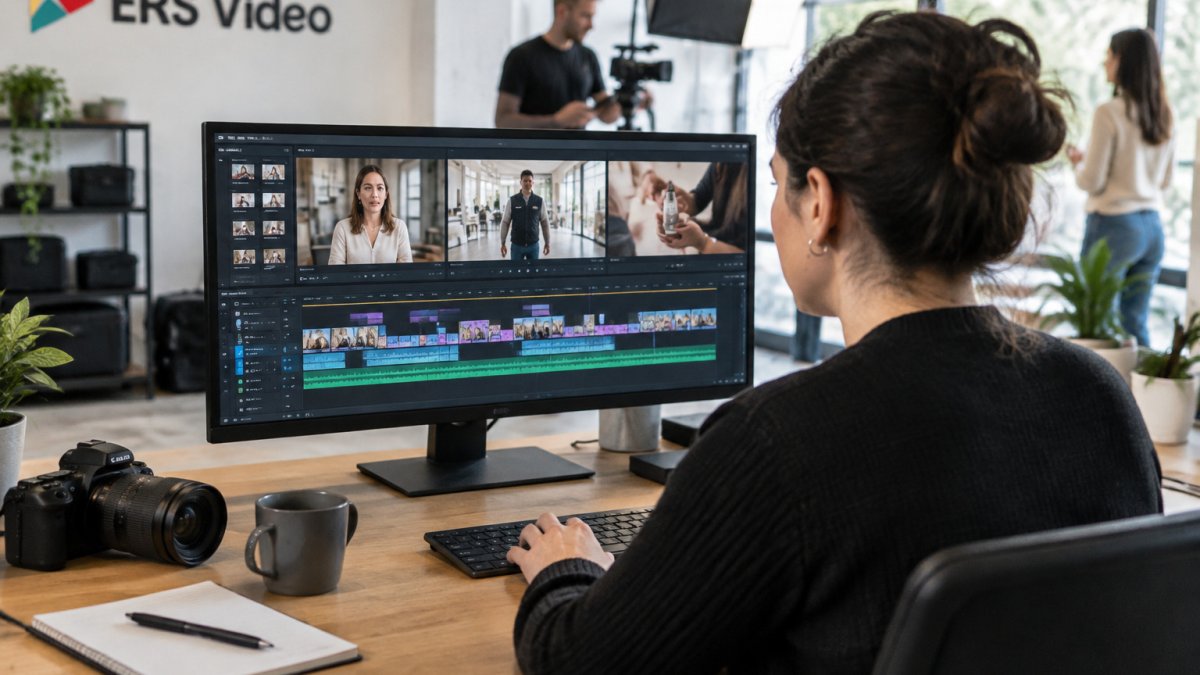
Once the main film is edited, pull out shorter versions for different channels: a 15-second teaser, a quote graphic from an interview, a vertical cut for social feeds and a longer edit for the website.
Be sure your rights allow reuse before you repurpose. Confirm with your production partner which deliverables you own and whether any licensed music or stock footage limits where the new edits can appear.
Building Scalable Video Content Without Losing Quality
A repeatable system protects quality as volume grows.
Set up a production calendar that batches shoots. Filming several assets in one session lowers the cost per asset, because crew and location costs are spread across more output.
Measure performance as you go. Track completion rate, click-through and conversions for each asset, then do more of what works.
Plan timelines early. Our realistic timelines for campaign production show how long each stage typically takes.
Booking Your Next Video Project With ERS Video
ERS Video produces bespoke promotional content, including interviews and filming at your place of work, along with aerial videography. You can see the full range of promotional video services on offer.
Pricing depends on your brief, so the most accurate way to budget is to share your goals, expected volume and timeline. Get in touch with ERS Video to book a call and talk through the right production model for your next project.
Frequently Asked Questions
How can businesses scale video production cost-effectively?
Plan video output around a fixed number of shoot days and get several deliverables from each one. A single filming session can yield a main promotional film, shorter cut-downs for social media, and stills for other channels. Agree the brief, deliverables and revision rounds before filming starts, because unplanned changes are a common cause of overspend. Pricing depends on scope, dates and delivery, so ask ERS Video for a quote tailored to your volume.
Is it cheaper to produce videos in-house or hire a production company?
It depends on volume and the skills you already have. In-house production avoids agency fees but needs equipment, editing software, staff time and training, and output can slow when those people are busy with other work. Outsourcing gives access to experienced crews and finished quality at a predictable price per project, which suits businesses that need occasional high-impact films. Many teams combine both, keeping simple social content in-house and commissioning larger promotional or event films externally. Compare the full cost of staff hours and equipment against a written quote before deciding.
What should a video production budget include?
A realistic budget covers pre-production such as scripting and planning, the shoot itself including crew and equipment, post-production covering editing, colour and sound, and any graphics or captions. Add interviews or on-site filming, aerial footage where needed, and licensing or music costs. Include VAT where it applies to your business, and allow for revision rounds and additional formats or lengths. Hidden costs often appear in re-edits, extra location time and rushed turnaround fees, so state these expectations in the brief. Ask ERS Video for a quote that itemises each stage so you can see what you are paying for.
