
Table of Contents
- What Corporate Video Production Service Costs Actually Cover
- A Full Video Production Cost Breakdown
- How Video Production Day Rates Work
- What Changes the Price: Factors That Move Your Quote
- Reading a Corporate Video Production Quote
- Building a Corporate Video Production Budget That Works
- Frequently Asked Questions
Last Updated: 18 October 2026
What Corporate Video Production Service Costs Actually Cover
Corporate video production service costs pay for three things: the planning before anyone films, the crew and kit on the day, and the editing that turns raw footage into something you can publish. Most quotes look high because buyers only picture the filming day. That day is often the smallest part of the bill.
This guide from ERS Video breaks down where the money goes, how day rates work, and how to read a quote without guessing. We work with small and mid-sized teams every week, so we know the budget question comes first.
Below, we’ll show you exactly how to compare quotes and spot padding. But first, here’s what most guides get wrong: they quote one big number and never explain the parts.
A Full Video Production Cost Breakdown
A video production cost breakdown splits your quote into pre-production, production, and post-production. Each stage carries its own people, time, and equipment. Ask any supplier to price these separately and you can compare quotes fairly.
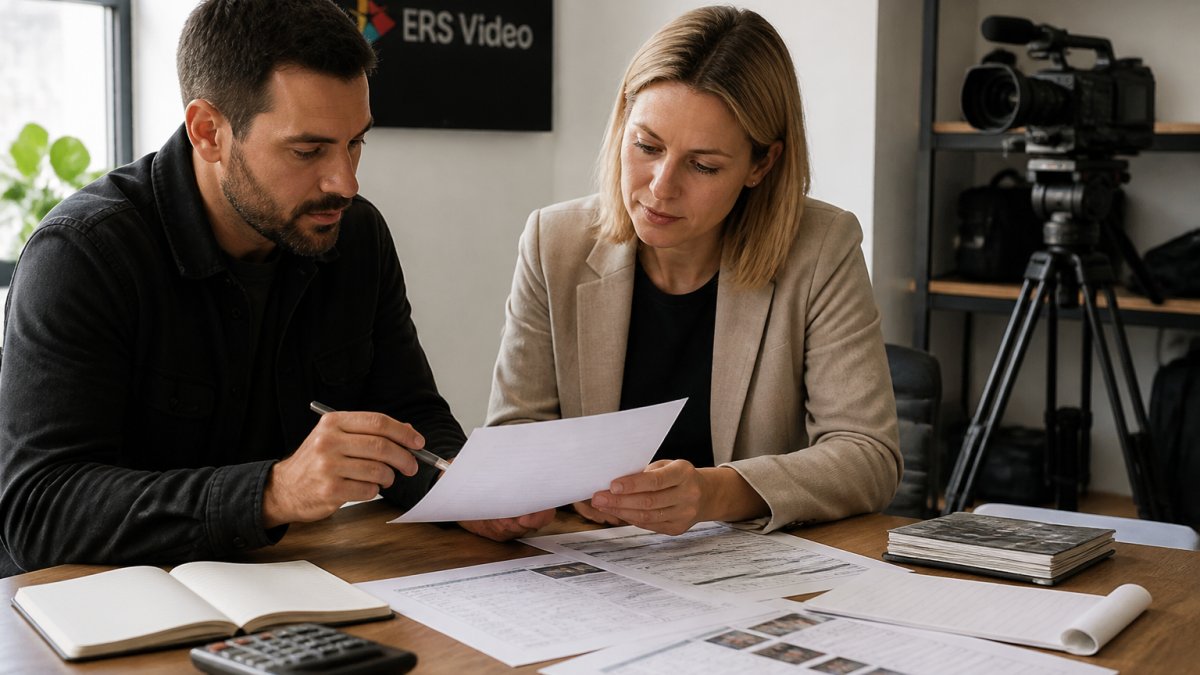
Pre-production: planning and scripting
Pre-production covers the work before a camera appears. That means the brief, the script or interview questions, location scouting, shot lists, and scheduling.
A common mistake is treating this stage as optional. Skip it and you pay for it later as reshoots or a video that misses the point. For interview-led films, this is also where questions get drafted so your team sounds natural on camera.
Production: filming days and crew
Production is the shoot itself: crew, camera, lighting, sound, and travel. A simple single-camera interview needs far less crew than a multi-location brand film with aerial shots.
Crew size drives this cost more than anything else. Each extra person adds a day rate, and each extra location adds setup and travel time.
Post-production: editing, sound and graphics
Post-production is where most of the hours hide. Editing, colour grading, sound mixing, music licensing, captions, and motion graphics all sit here.
The rule of thumb: the more versions you need, the more this stage costs. One hero film plus three short social cuts is more work than one film alone.
How Video Production Day Rates Work
A video production day rate is the price for one crew member or one kit item for a standard filming day, usually ten hours. Rates vary by role and experience, so always ask what a “day” includes.
Here’s how to read the typical roles in a quote:
- Director or producer: runs the shoot and keeps it on schedule
- Camera operator: owns framing, movement, and image quality
- Sound recordist: captures clean audio, which is harder than it looks
- Assistant: handles kit, lighting, and setup
- Equipment: camera, lenses, lighting, and audio hire
Two things catch buyers out. First, overtime: a long shoot day often triggers extra hourly charges. Second, prep and travel days, which some suppliers bill and others build into the rate. Ask which applies before you sign.
The most expensive mistake is booking the cheapest day rate without checking what it excludes. Editing, music licensing, and travel are commonly left out, so the final invoice can land well above the quote. Confirm inclusions in writing.
What Changes the Price: Factors That Move Your Quote
Location count, crew size, filming days, and edit complexity move a corporate video production quote more than anything else. Animation and aerial filming add cost too, because both need specialist skills and kit.
Here’s what pushes a quote up or down:
- Number of filming days. Two short days usually cost less than one very long day.
- Locations. Each new site adds travel, setup, and packing time.
- Talking heads vs. scripted scenes. Interviews are faster to film; scripted scenes need actors and retakes.
- Graphics and animation. Bespoke animation is skilled work and priced accordingly.
- Aerial videography. Drone work needs a qualified pilot and adds planning time.
- Deadline. A tight turnaround often means overtime or extra editors.
- Usage and licensing. Music and footage licences vary by where and how long you use the video.
A useful sanity check: the more people and places involved, the more the price climbs. Simple briefs shot in one place with one camera sit at the lower end.
Reading a Corporate Video Production Quote
A good quote is itemised, dated, and clear about what is and isn’t included. If you get a single lump sum with no breakdown, ask for the detail before you compare it to anything.
Run every quote through this checklist:
- Is pre-production, production, and post-production priced separately?
- Are crew roles and day rates listed by name?
- Is equipment hire included or billed on top?
- How many edit rounds are included, and what does an extra round cost?
- Is music licensing covered, and for how long?
- Are travel and expenses capped or open-ended?
- What is the delivery timeline, and what happens if it slips?
- Are captions and social cuts included or extra?
Ask each supplier to quote the same brief, word for word. When everyone prices identical work, the differences you see are real differences in approach, not differences in what was asked for. It makes the comparison honest.
Building a Corporate Video Production Budget That Works
Start with the outcome, not the number. Decide what the video must achieve, then work backwards to the simplest production that gets you there. A corporate video production budget built this way rarely overspends.
Set aside a contingency of roughly ten to fifteen per cent for changes. Most projects involve at least one revision to the brief or the edit, and a small buffer stops that becoming a difficult conversation.
Where to spend and where to save
Spend on the things viewers notice: clean sound, good lighting, and a tight edit. Those three carry more weight than expensive camera bodies.
Save on things viewers don’t see. One strong location beats three average ones. Two well-planned filming days beat four rushed ones. And a clear script saves hours in the edit suite.
| Priority | Spend here | Save here |
|---|---|---|
| Sound | Professional recordist and mics | Cheap lavaliers that pick up wind |
| Lighting | Controlled, soft key light | Extra locations for better light |
| Edit | Tight pacing and clean graphics | Fancy transitions nobody needs |
| Planning | Clear brief and shot list | Reshoots from a vague brief |
| Delivery | One hero film plus short cuts | Dozens of versions nobody uses |
If you’re weighing bespoke production against a cheaper automated tool, be honest about the goal. A template video can fill a gap. A brand film that has to win trust usually needs a real crew, real interviews, and a proper edit.
At ERS Video, we keep the process personal and flexible, which matters when you’re a smaller team with a fixed budget. We film interviews at your workplace, add aerial footage where it helps, and price the work around your brief rather than a fixed package.
Frequently Asked Questions
How much does corporate video production cost?
There is no single figure, because corporate video production costs depend on the scope of the project. A short interview-led promotional video needs fewer filming days, crew and editing hours than a multi-location campaign with aerial footage and motion graphics. Each production company builds its quote from pre-production time, filming days, equipment and post-production hours. Ask for an itemised quote so you can see exactly what drives the total, and request a tailored estimate from ERS Video based on your brief rather than relying on generic online averages.
What factors affect the cost of a corporate video?
The biggest cost drivers are the number of filming days, the size of the crew, the number of locations, and the amount of editing and graphics work. Video length matters less than complexity: a tightly scripted two-minute film can cost more than a longer talking-head piece if it involves multiple setups, actors or animation. Aerial videography, on-screen interviews, bespoke music and extra revision rounds all add to the total. Sharing a clear brief and a firm deadline early helps a production company scope the work accurately and avoid surprise extras.
How can I reduce corporate video production costs without losing quality?
Plan the video around one clear message and one or two locations, and film several pieces of content in the same session. Reusing existing brand assets, choosing a single filming day and limiting revision rounds to two all keep the budget down. Booking in advance also helps, since rushed timelines often mean overtime or premium scheduling. A flexible production company can suggest ways to film interviews and b-roll in a single visit, which spreads the cost across more than one video and protects the quality of the final edit.
Does video length affect production costs?
Length has some effect, mainly on editing time, but it is rarely the main driver. A long single-camera interview can be cheaper to produce than a short, highly polished advert with animation and multiple filming days. What matters most is how many setups, locations and post-production hours the video needs. When you discuss your corporate video production budget with a supplier, focus on the complexity of the content and the number of deliverables rather than the runtime alone. That gives you a more accurate picture of where the money goes.
The hardest part of video budgeting isn’t the number. It’s knowing which parts of a quote actually earn their place.
ERS Video offers bespoke video production with a personal, flexible approach, including interviews filmed at your workplace and aerial videography where it adds value. We’ve built a reputation for cost-effective work, reflected in a verified Trustindex score above 4.5.
Book a call with ERS Video and get a clear, itemised quote built around what your video needs to achieve.