
Table of Contents
- How Video Production and AI Generators Compare at a Glance
- Video Production vs AI Generators: A Detailed Feature Breakdown
- Pros and Cons of Human-Led Video Production
- AI Video Generator Limitations for Branding
- Best Practices for Corporate Video Production
- Measuring Return on Investment for Small Business Video Marketing
- Which Approach Fits Your Business?
- Conclusion
- Frequently Asked Questions
Last Updated: 23 September 2026
How Video Production and AI Generators Compare at a Glance
Video production is the human-led process of planning, filming, and editing footage with a real crew, while AI generators create video from text prompts and stock libraries. The two sit at opposite ends of a trade-off: authenticity and control versus speed and low upfront cost. This guide from ERS Video breaks down where each approach wins, where it falls short, and which one fits a small business budget in 2026.
The core difference is simple. A camera captures your actual team, premises, and customers. An AI tool assembles clips that were never filmed at your business. That distinction drives everything else, from trust to cost.
Here is the short version before the detail:
| Factor | Human-Led Video Production | AI Video Generators |
|---|---|---|
| Source of footage | Real filming on location | Stock clips and generated visuals |
| Upfront cost | Higher, project-based | Low monthly subscription |
| Turnaround | Days to weeks | Minutes to hours |
| Brand authenticity | High | Limited |
| Best for | Promotional and event films | High-volume social content |
Video Production vs AI Generators: A Detailed Feature Breakdown
The practical gap shows up in four areas: footage, control, consistency, and scalability. Human-led production gives you footage that exists nowhere else, because it is your business on camera. AI tools give you volume, because a single prompt can produce a finished clip in minutes.
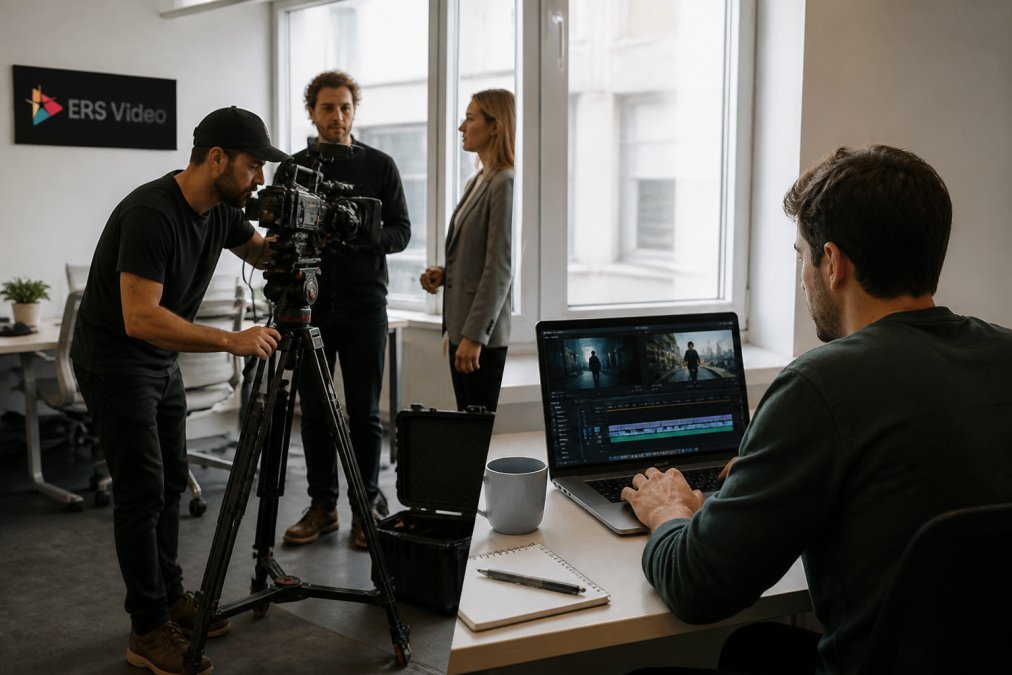
On control, a director adjusts lighting, framing, and performance in real time. An AI generator works from a prompt, so fine detail is often approximate. On consistency, a production team can match your brand colours, tone, and messaging across every video. AI output tends to drift between clips.
Scalability flips the advantage. If you need fifty short clips a month, automation wins on sheer output. If you need one film that represents your company properly, filming wins.
Choose based on volume and stakes. High-volume, low-stakes content suits AI. Low-volume, high-stakes content suits a production team.
Pros and Cons of Human-Led Video Production
The strongest argument for filming is trust. A promotional video that shows real staff, real premises, and real customers is difficult to fake, and viewers notice the difference. ERS Video builds this into its process by filming interviews and on-site footage, so the result reflects the business as it actually is.
The advantages stack up quickly:
- Authentic footage of your team, site, and customers
- Full creative control over lighting, sound, and pacing
- Content that holds up on a website, at events, and in pitches
- Aerial videography for property and location work
The honest drawbacks are cost and time. A bespoke shoot needs planning, a filming day, and editing, so it costs more and takes longer than typing a prompt. That is the trade you are making, and for most promotional work it is worth it.
AI Video Generator Limitations for Branding
AI video generator limitations for branding come down to one problem: the footage is not yours. Stock clips and generated visuals can look polished, but they carry no trace of your business. Viewers increasingly recognise the generic look, and it weakens the message.
Three limits matter most for brand work. First, consistency is hard to hold, because each clip is generated separately and small details shift. Second, customisation is shallow, since you are choosing from existing footage rather than capturing your own. Third, emotional connection is thin, because no real person from your company appears on screen.
For internal training or quick social updates, those limits are acceptable. For a brand film meant to win clients, they are not.
Using stock-heavy AI video for a customer-facing brand film can make your business look interchangeable with every competitor. The saving on production is usually lost in weak engagement.
Best Practices for Corporate Video Production
Good corporate video starts with a clear objective, not a camera. Decide what the video must achieve, who will watch it, and where it will run before any filming begins. That single step separates films that perform from films that sit unused.
A workable process looks like this:
- Define one goal per video, such as enquiries or event promotion
- Write a short script or interview plan around that goal
- Scout the location and plan lighting and sound
- Film with enough coverage to allow flexible editing
- Edit to a tight runtime, then review against the original goal
What most guides miss is the review stage. Build in one round of feedback before final delivery, so the finished film matches what you set out to say.
Measuring Return on Investment for Small Business Video Marketing
Measuring return on investment for small business video marketing means tracking what the video actually changed, not just how many people watched it. Views are a vanity number on their own. The useful signals are enquiries, bookings, and sales that trace back to the video.
Set a baseline before launch, then compare. Record enquiries in the month before the video goes live, then in the month after. Note where the video appears, such as a landing page or email campaign, so you can attribute results.
Useful metrics to track:
- Enquiry or booking rate before and after launch
- Time on page for pages hosting the video
- Click-through from email or social posts featuring the video
- Cost per enquiry against the production cost
If the video drives enquiries at a lower cost than your other channels, it is earning its place. If not, the message or placement needs work, not necessarily a bigger budget.
Ask every new enquiry how they found you for the first month after launch. A simple “where did you hear about us?” field often reveals video performance faster than analytics alone.
Which Approach Fits Your Business?
Pick human-led video production if the content represents your brand to customers, if authenticity matters, or if the video needs to last. Promotional films, event coverage, and property walkthroughs fall into this group, and this is where a bespoke team earns its cost.
Pick AI generators if you need volume, speed, and low cost, and the stakes are low. Social snippets, quick internal updates, and testing ideas all suit automation.
For most small businesses, the answer is both. Use AI for the high-volume, low-stakes content, and commission professional filming for the pieces that carry your reputation. ERS Video focuses on that second category: bespoke promotional and event video, filmed on location, with interviews and aerial footage where useful.
Conclusion
The real decision is not which tool is better, but which content deserves real footage. Get that split right and your budget goes where it earns the most.
Frequently Asked Questions
Is AI video generation suitable for professional brand marketing?
AI video generation can work for simple, high-volume tasks like social media clips or internal training. However, for brand marketing that needs to build trust and emotional connection, AI often falls short. It struggles with authentic storytelling, consistent brand voice, and the nuanced human elements that make a campaign memorable. For businesses looking to stand out, a bespoke video production approach remains more effective.
What are the limitations of AI video generators compared to human production?
AI video generators have several limitations for branding. They often rely on stock footage or generic avatars, leading to a lack of originality. They cannot capture genuine interviews, real workplace culture, or the specific details that make your business unique. Additionally, AI tools may struggle with complex narratives, subtle emotional cues, and the strategic alignment that a professional production team provides.
How does the cost of professional video production compare to AI subscriptions?
AI video generators typically charge monthly subscriptions. Professional video production is project-based, with pricing depending on scope, filming days, and post-production needs. While the upfront cost is higher, bespoke production delivers a tailored asset that can be reused across campaigns.
How do I measure the return on investment for video marketing?
To measure ROI for small business video marketing, track metrics like view-through rates, engagement, click-throughs, and conversions. Use unique landing pages or UTM codes to attribute leads to your video. Compare the cost of production against the revenue generated from those leads. Also consider brand lift and customer lifetime value, as video can influence purchasing decisions over time.
Choosing between automated clips and a properly filmed brand video is a budget question with a reputation attached. ERS Video offers a personal, flexible service with bespoke content, on-site interviews, and aerial videography, delivered as cost-effective production for SMEs and private clients. Book a call with ERS Video and get a promotional film that shows your business at its best.