
Table of Contents
- Start With Strategy, Not a Camera: Professional Brand Video Production Tips That Save Money
- Define the One Job Your Video Has to Do
- Match the Format to the Platform Before You Shoot
- Use a Brand Video Script Template to Lock Down Your Message
- How Long Should a Brand Video Be? Match Length to Where It Plays
- Study Strong Brand Video Examples Before You Commission Anything
- Video Production Best Practices: Lighting, Sound and Interviews
- Where a Professional Brand Video Production Partner Earns Its Fee
- Conclusion: Turn These Tips Into a Brief You Can Hand Over
- Frequently Asked Questions
Last Updated: 12 October 2026
Start With Strategy, Not a Camera: Professional Brand Video Production Tips That Save Money
Most businesses lose money on video before the camera is even switched on. Professional brand video production tips that actually save budget all begin in the same place: a written decision about what the video must achieve.
Brand video production is the process of planning, filming and editing a video that represents a company’s identity and message to a specific audience. It differs from general content creation because every choice, from script to lighting, serves one commercial purpose.
That purpose has to be decided before anything else. Here is the sequence we recommend, and the mistakes we see most often.
Write your success measure on one line before you brief anyone: “This video should get X response from Y audience.” If you cannot fill in both blanks, the project is not ready to start.
Define the One Job Your Video Has to Do
A brand video fails when it tries to do four jobs at once. The most common mistake is asking a single film to explain the company, introduce the team, showcase a product and drive enquiries. Pick one job and the rest becomes easier.
Ask three questions:
- Who is watching, and what do they already know about you?
- What single action should they take after watching?
- Where will this video sit, and what surrounds it there?
The answers decide everything downstream. A recruitment video needs different pacing and tone from a sales video, even when both feature the same building and the same people.
Match the Format to the Platform Before You Shoot
Format follows platform, not the other way around. A video shot for a website hero banner rarely works as a social clip, and the reverse is just as true. Decide the destination first, then commission accordingly.
| Platform | Typical Length | Aspect Ratio | Primary Job |
|---|---|---|---|
| Website homepage | 60-90 seconds | 16:9 landscape | Explain and reassure |
| Social feed | 15-45 seconds | 9:16 vertical | Stop the scroll |
| Sales presentation | 2-3 minutes | 16:9 landscape | Answer objections |
| Event or launch | 60-120 seconds | 16:9 landscape | Capture atmosphere |
Shooting vertical and landscape versions in the same session costs far less than returning for a second film day. Plan for both in the original brief.
Use a Brand Video Script Template to Lock Down Your Message
A brand video script template stops the message drifting during filming. It also gives everyone something concrete to approve before money is spent on crew time.
The Five-Block Structure That Works for Almost Any Business
This structure suits promotional videos, interviews and event films alike:
- Hook (0-10 seconds): The problem, question or claim that earns attention.
- Context (10-30 seconds): Who you are and why you are credible.
- Proof (30-90 seconds): A customer story, a demonstration, or a member of staff explaining their work.
- Offer (90-110 seconds): What you do and who it is for.
- Call to action (110-120 seconds): One clear next step, stated plainly.
Write the script in spoken language. Read it aloud. If a sentence sounds like a brochure, rewrite it until it sounds like a person.
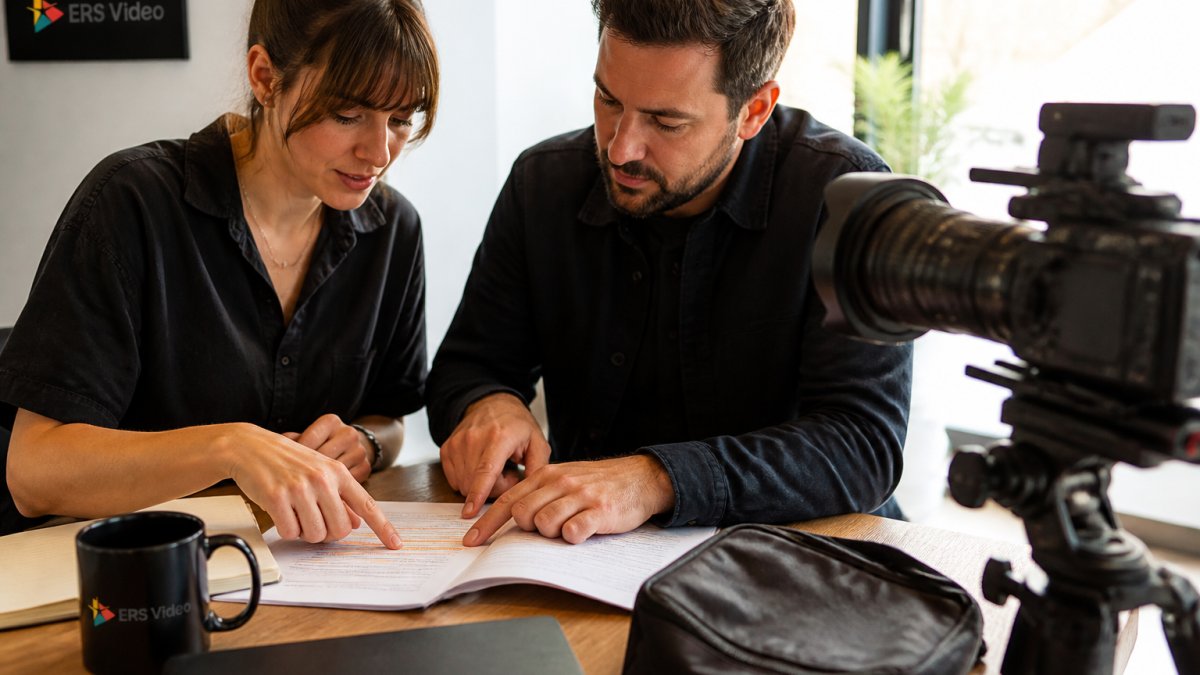
The most expensive mistake in script approval is changing the message after the shoot. Reshoots cost a full production day. Lock the script in writing, get sign-off from everyone with veto power, and treat later changes as a new project.
How Long Should a Brand Video Be? Match Length to Where It Plays
The right length is the shortest time in which the video completes its job. There is no universal ideal, and any guide quoting a single number is guessing.
For most business promotional films, 60 to 90 seconds covers the hook, context, proof and offer without padding. Sales and explainer videos can run to two or three minutes because the viewer has already chosen to watch. Social clips work best under 45 seconds.
Test this yourself. Watch your draft and note the moment your attention drops. That timestamp, minus ten seconds, is usually your real running time.
Study Strong Brand Video Examples Before You Commission Anything
Good brand video examples teach you what to ask for. Watch ten videos from outside your sector and note what holds your attention: the opening line, the pace of the cuts, whether anyone speaks directly to camera.
Build a short reference list and share it with your production partner. It is far easier to say “like this, for our business” than to describe tone from scratch.
A reference list of three to five videos, with one sentence on what you like about each, removes more ambiguity from a brief than any amount of written description.
Video Production Best Practices: Lighting, Sound and Interviews
Sound quality decides whether viewers stay. Poor audio drives people away faster than soft focus ever will, and it is the single most common weakness in self-shot business video.
Fix the Sound Before You Fix the Picture
Move the microphone close to the speaker, not the camera. A lapel mic or a boom just out of frame will beat a camera-mounted mic every time. Record in a soft-furnished room, switch off air conditioning and fridges, and ask everyone to silence phones.
For lighting, use soft, directional light on the face and avoid windows directly behind the subject. If the room is bright and flat, that is usually good enough. Complexity is not the goal.
Interviews work when the questions are good. Prepare six to eight open questions, ask them in a relaxed order, and let people finish their sentences. The best answers often come after the camera has been rolling for ten minutes.
Where a Professional Brand Video Production Partner Earns Its Fee
A production partner earns its fee through planning, not equipment. Anyone can buy a camera; the value sits in knowing what to shoot, how to light it, how to record clean audio, and how to cut it into something that holds attention.
This is where we work at ERS Video. Our approach is personal and flexible: we plan around your message, film interviews at your workplace, and can add aerial videography where a location benefits from it. Clients such as ShieldCrest Publishing have described us as easy to work with and helpful during the process, and Deborah Parritt called our service “fantastic” and cost-effective.
That matters for smaller businesses. You do not need a large budget to get footage that looks and sounds professional. You need a clear brief, a sensible format decision, and a partner who will tell you honestly when an idea will not work on screen.
Small and mid-sized businesses that want bespoke promotional video without agency overheads, and value a partner who explains each decision as the project moves.
Conclusion: Turn These Tips Into a Brief You Can Hand Over
The gap between a video that performs and one that sits unused is nearly always a planning gap, not a budget gap. Decide the job, choose the format, write the script, and settle the sound before anything else.
If you would rather hand that thinking to someone who does it every week, we can help. ERS Video offers bespoke video content, on-site interviews, aerial videography and a personal, flexible service built around your objectives. Book a call with us and we will turn your brief into a video that shows your business at its best.
Frequently Asked Questions
How much does professional brand video production cost?
Costs vary widely depending on the length of the finished video, the number of filming days, crew size, location, aerial footage and how much editing or animation you need. A single interview-led promotional video costs far less than a multi-location campaign. Rather than quote a figure that may not fit your brief, ask for an itemised quote based on your script and shot list. Pricing depends on quantity, dates and delivery, so book a call and share your brief for an accurate figure.
How long should a brand video be?
Match the length to where the video will play. A social media teaser often works best at 15 to 30 seconds, a homepage hero video at 60 to 90 seconds, and an in-depth brand story or explainer at two to three minutes. Anything longer needs a strong reason, such as a documentary-style case study or a training video. If you are unsure, script the shortest version that still makes your point, then cut a longer edit for your website.
What should a brand video script template include?
A practical template covers five blocks: an opening hook that names the problem, a short introduction to who you are, the core message or service explained in plain language, proof such as a customer quote or result, and a single clear call to action. Keep each block to a few sentences and read it aloud before filming. If it sounds like a brochure, rewrite it. The template should also note shot ideas beside each line so the edit is easy to assemble.
What makes a brand video effective?
Effective videos share three traits: a clear single message, good sound, and a call to action the viewer can act on immediately. Visual polish matters, but poor audio or a muddled message will lose viewers faster than slightly softer lighting. Study brand video examples in your sector and note how quickly they state the problem and who it is for. Then apply the same discipline to your own script before you book any filming.
Can you show examples of promotional videos you have made for businesses like ours?
Yes. Ask any production company for recent work in your sector before you commit. ERS Video has produced promotional films for clients including ShieldCrest Publishing, who described the process as easy, professional and full of helpful advice, and business owner Zoe Neal, who said the final video captured her and her participants perfectly. Seeing comparable work is the fastest way to judge whether a production partner understands your brand.