
Table of Contents
- Step 1: Set the Right Video Engagement Metrics Before You Film
- Step 2: Choose the Best Video Length for Engagement on Each Platform
- Step 3: Apply Video Storytelling Techniques That Hold Attention
- Step 4: Write Video Calls to Action That Viewers Actually Follow
- Step 5: Use Thumbnails, Titles and Captions to Win the First Click
- Step 6: Promote and Distribute Your Video to Reach the Right Viewers
- Common Mistakes That Kill Video Engagement
- Conclusion
- Frequently Asked Questions
Last Updated: October 7, 2026
Step 1: Set the Right Video Engagement Metrics Before You Film
Most teams film first and check the numbers later. That is backwards. If you want to know how to improve video engagement, you need to decide what “engaged” actually means before anyone picks up a camera. This guide from ERS Video breaks the process into six steps you can follow today.
Video engagement metrics are the measurements that show how viewers interact with your content, not just whether they pressed play. The key ones are:
- Watch time: total minutes viewed across all viewers
- Average view duration: how long a typical viewer stays
- Retention rate: the percentage still watching at any given point
- Click-through rate: how many viewers act on your call to action
- Comments and shares: active signals, not passive views
Views tell you a video was seen. These five tell you whether it worked.
A common mistake is chasing view counts alone. A video with 10,000 views and a 10% retention rate has done less for your business than one with 1,000 views and an 80% retention rate. The second audience actually watched.
Pick two or three metrics that match your goal. A brand awareness video lives or dies on retention. A sales video lives or dies on click-through. Measure what matters, ignore the rest.
Set your target metrics before the shoot, not after. If you decide post-filming that retention was always the goal, you will edit for the wrong thing and miss it.
Step 2: Choose the Best Video Length for Engagement on Each Platform
Finding the best video length for engagement starts with one rule: shorter is usually safer, but only if the story still lands. A video that runs 30 seconds and says nothing beats nothing at all.
Platform habits differ. Viewers scroll on social feeds and settle in on websites. Match your length to where the video will live.
Recommended Lengths by Platform
| Platform | Ideal Length | Why It Works |
|---|---|---|
| Social feeds | 15-60 seconds | Matches scroll behaviour |
| Website landing pages | 60-120 seconds | Viewers arrive with intent |
| Promotional brand videos | 90-180 seconds | Room for story and proof |
| Event and wedding films | 3-6 minutes | Emotional payoff needs time |
These are starting points, not laws. Test two lengths of the same video and compare retention. The data will settle the argument faster than opinion ever will.
One insider note: the first 10 seconds matter more than the total runtime. If viewers drop off in the opening, a shorter edit will not save you.
Step 3: Apply Video Storytelling Techniques That Hold Attention
Strong video storytelling techniques turn a list of features into something a viewer wants to finish. The structure matters more than the budget.
Hook, Build, Resolve: A Three-Part Structure
Every effective video follows the same shape:
- Hook: open with the problem or a bold claim in the first few seconds
- Build: show how the problem gets solved, with proof and real people
- Resolve: land the outcome and tell viewers what to do next
What most guides miss is that the hook does not need to be dramatic. It needs to be specific. “We cut our client’s enquiry-to-quote time in half” beats “Welcome to our channel” every time.
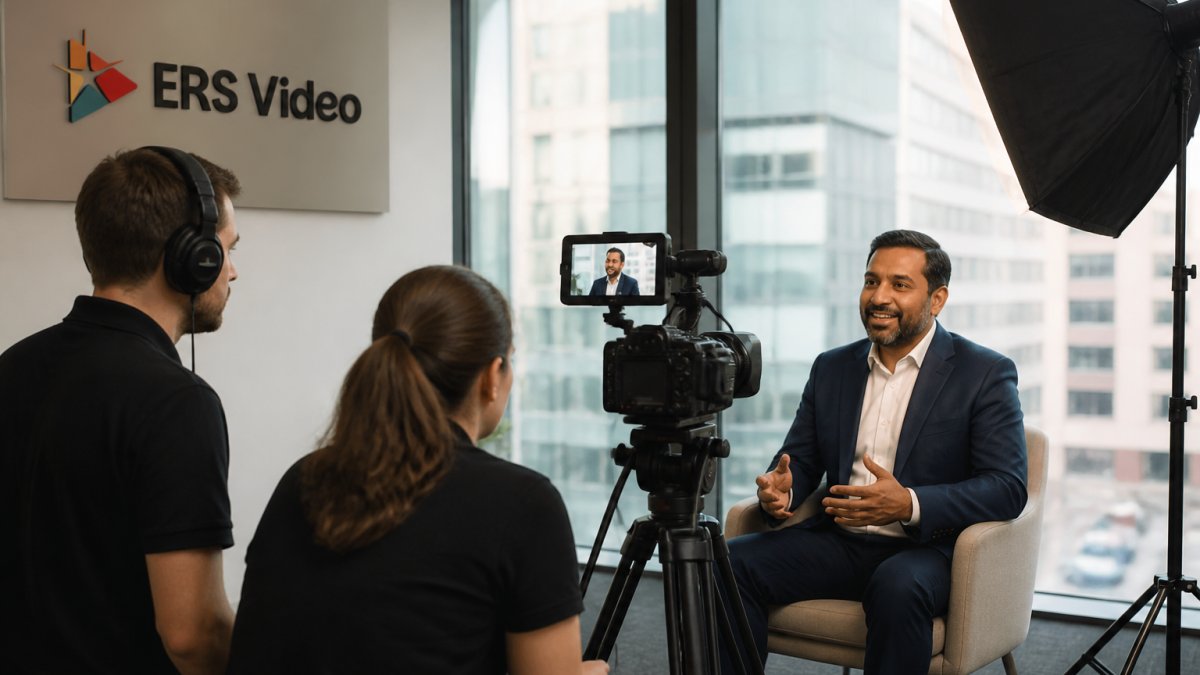
Talk to real people on camera where you can. Interviews with staff and customers carry more weight than a voiceover reading a script. At ERS Video, we film interviews and on-site footage for exactly this reason: real faces hold attention longer than stock clips.
Step 4: Write Video Calls to Action That Viewers Actually Follow
A video call to action is the specific instruction you give viewers at the end of your video. Weak CTAs ask for nothing. Strong ones name the next step.
Compare these:
- Weak: “Thanks for watching. Like and subscribe.”
- Strong: “Book a 15-minute call using the link below to see if this fits your business.”
The strong version works because it is clear, low-commitment, and tied to a real outcome. Put your CTA on screen as text as well as in the script. Viewers often watch with sound off.
Place one CTA near the end and, if the video runs over 90 seconds, a soft reminder halfway through. Never stack three asks in a row. One clear request beats three competing ones.
Step 5: Use Thumbnails, Titles and Captions to Win the First Click
Retention means nothing if nobody clicks. Your thumbnail, title and captions do the heavy lifting before the video even starts.
A few rules that hold up in practice:
- Use a real face or a clear product shot in the thumbnail, not a logo
- Keep titles under 60 characters so they do not get cut off
- Add captions to every video, since many viewers watch on mute
- Match the thumbnail to the video’s actual content, or viewers will feel tricked and leave
Captions also help viewers who are deaf or hard of hearing, and they make your content searchable. That is a rare case where accessibility and reach pull in the same direction.
Clickbait thumbnails that overpromise will spike clicks and then tank retention. Platforms read that drop-off as a quality signal and show your next video to fewer people.
Step 6: Promote and Distribute Your Video to Reach the Right Viewers
A great video with no distribution plan is a private screening. Promotion is how you improve video engagement after the edit is locked.
Start with the channels you already own:
- Embed the video on a relevant page of your website
- Send it to your email list with a short, personal note
- Post a cut-down version to your social channels
- Share it with partners and clients who might pass it on
Then look outward. A short paid boost to a tightly defined audience often beats a broad one. Match the platform to the viewer: a business audience behaves differently from a wedding audience, so the same clip will not work everywhere.
Track where each viewer came from. If one channel drives far better retention than another, put more effort there and less everywhere else.
Common Mistakes That Kill Video Engagement
The fastest way to improve video engagement is to stop making the same errors. These come up again and again:
- Burying the point: the first 10 seconds should carry the message, not a long intro
- Filming without a plan: no clear goal means no clear edit
- Ignoring sound quality: viewers forgive soft images but not muffled audio
- No call to action: the viewer finishes and does not know what to do next
- One version for every platform: a website film and a social clip need different edits
Fix two or three of these and retention usually moves within a single campaign.
The single biggest lever is the opening 10 seconds. Nail the hook and the rest of your video gets a fair chance.
Conclusion
Getting viewers to watch to the end is genuinely hard, and guessing your way through it wastes time and budget. A production partner who understands retention, story and distribution changes the odds.
ERS Video offers bespoke video content, including interviews and on-site filming, plus aerial videography to make your business or event stand out. Our clients include ShieldCrest Publishing, who found the process professional and well-advised, and Zoe Neal, who said we captured her and her participants perfectly.
Book a call with ERS Video and turn your next video into one people actually finish.
Frequently Asked Questions
How can I improve engagement on my videos without a big budget?
Start by reviewing your video engagement metrics in the platform’s analytics. Look at where viewers drop off and shorten that section. Write a clear script with a strong hook in the first five seconds, add captions for silent viewing, and end with one specific call to action. These cost nothing but time. For businesses that need a professional result, a bespoke production company can film interviews and on-site footage that holds attention far better than a phone recording.
What video length gets the most engagement?
There is no single best video length for engagement, but the platform matters. Short-form clips under 60 seconds suit social feeds and vertical formats. Two to five minutes works well for product demos and explainers. Longer pieces, up to ten minutes, can perform on YouTube if the content is genuinely useful and the pacing stays tight. Test two versions of the same message at different lengths and compare completion rates in your analytics.
How do you measure video engagement?
Key video engagement metrics include average view duration, completion rate, click-through rate on calls to action, comments, shares and saves. Watch time matters more than raw view counts because it shows whether people actually watched. Compare these figures across your last five videos to spot patterns. If completion drops sharply at a certain point, that section needs cutting or rewriting. Review metrics monthly rather than after every single post.
How do you keep viewers watching a video to the end?
Open with the payoff, not a long introduction. State what the viewer will get within the first few seconds. Use video storytelling techniques such as a problem-and-solution structure, keep segments short, and change the visual scene every few seconds with cutaways, graphics or different camera angles. Place your video calls to action at natural pause points rather than only at the end, so viewers who leave early still see them.