
Table of Contents
- How to Create Promotional Videos: What You’ll Need Before You Start
- Step 1: Write a Promotional Video Script Template That Works
- Step 2: Plan Your Shoot and Capture Footage
- Step 3: Edit Your Video for Maximum Impact
- The Ideal Length for Business Promo Videos
- Understanding the Cost of Bespoke Business Video Production
- Building a Video Marketing Strategy for SMEs
- Conclusion
- Frequently Asked Questions
Last Updated: October 4, 2026
How to Create Promotional Videos: What You’ll Need Before You Start
Creating promotional videos that actually earn attention starts long before anyone switches on a camera. According to Ofcom’s Online Nation report, viewers now spend more time watching video online than ever, which means the bar for holding attention keeps rising. At ERS Video, we’ve produced promotional content for SMEs, publishers and private clients, and the projects that succeed share one thing: a clear plan made before filming begins. Below, we break down exactly how to create promotional videos step by step, from script to final export. The five stages we cover are the same ones we use on every bespoke project.
Promotional videos are short, purpose-driven films made to inform an audience about a business, product or event and prompt a specific response, such as an enquiry or a booking.
Defining Your Goal and Audience
The biggest mistake we see is filming first and deciding the purpose later. A promotional video needs one job. Is it introducing a company, launching a product, or filling an event? Write the goal in a single sentence, then name the audience: a procurement manager watches differently from a bride-to-be. That sentence becomes the filter for every decision that follows, from script tone to running time.
Essential Equipment and Software
You do not need a cinema camera to start. A modern mirrorless body, a lavalier or shotgun microphone, and two LED panels will carry most SME projects. Sound matters more than resolution; viewers forgive soft footage but not muffled speech. For editing, mainstream nonlinear editors handle colour, captions and audio clean-up. If aerial shots would strengthen the story, plan them as a separate, budgeted element rather than an afterthought.
Step 1: Write a Promotional Video Script Template That Works
A promotional video script template is a reusable document that pairs a two-column layout (visuals on the left, spoken words on the right) with a fixed structure: hook, problem, solution, proof, call to action. A good template saves hours, because you stop reinventing the format on every project. Here is the one we start clients with:
PROMOTIONAL VIDEO SCRIPT TEMPLATE
Title: [Project name] Target length: [e.g. 60 seconds] Goal: [One sentence]
Visual Audio 0:00-0:05 Hook: [Striking shot of the product, team or location] [One line that names the viewer’s problem] 0:05-0:20 Problem: [Everyday scene showing the frustration] [Two sentences describing the pain point in the customer’s words] 0:20-0:40 Solution: [Product in use, close-ups of key details] [What you offer and how it works] 0:40-0:50 Proof: [Customer or team member speaking to camera] [One specific result or endorsement] 0:50-0:60 CTA: [Logo, website, phone number on screen] [Single, clear instruction]
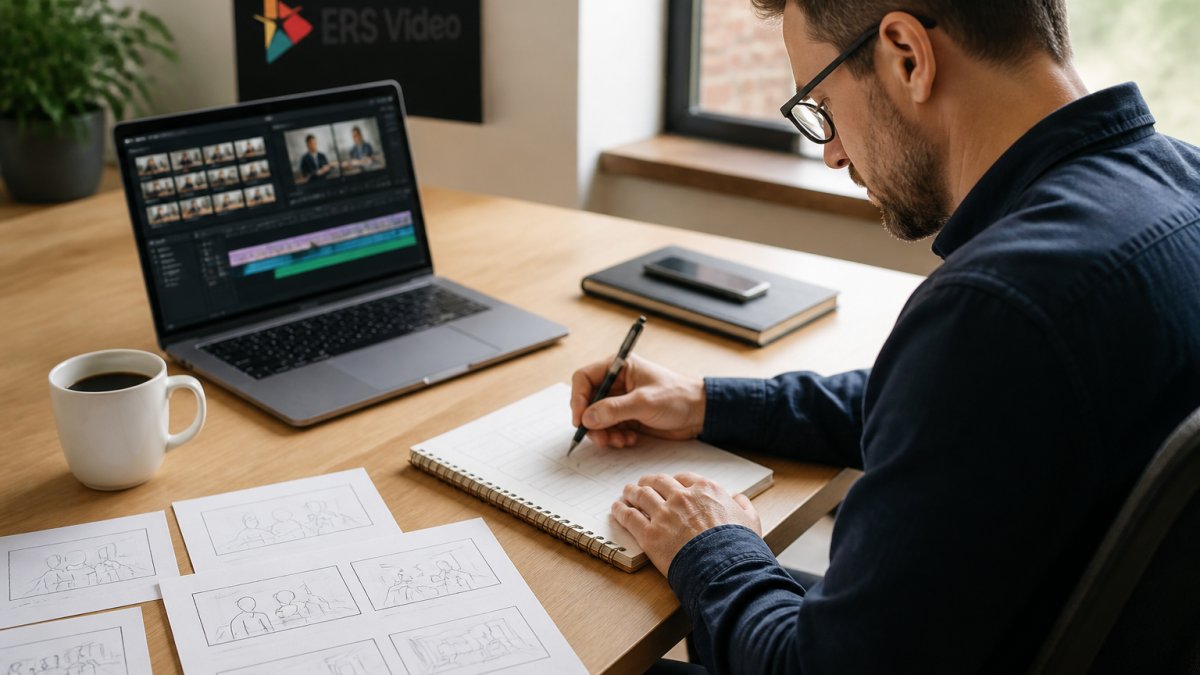
Write the call to action before anything else. When the ending is fixed, the middle writes itself, and you avoid the classic trap of a beautiful video that asks the viewer to do nothing.
Step 2: Plan Your Shoot and Capture Footage
Shooting days go wrong when planning is thin. Lock the location, check power and parking, and agree a running order with your team the day before. Film the call to action first while energy is high, then work through the script. Capture more coverage than the edit needs: cutaways of hands, screens, signage and surroundings give the editor options when a line falls flat.
Filming Interviews and Behind-the-Scenes Content
Interviews and behind-the-scenes footage are what separate a promotional video from an advertisement. Real staff and customers speaking naturally build trust that a voiceover cannot. Set the interviewee slightly off-centre, light them from the front, and ask open questions so answers run longer than you need. Behind-the-scenes clips of the workshop, kitchen or studio also make excellent short-form cutdowns for social media.
Step 3: Edit Your Video for Maximum Impact
Editing is where a promotional video earns or loses its audience. Assemble the strongest take of each line first, then tighten. Cut every pause, filler word and repeated idea; a first assembly is usually a third longer than the final cut. Add captions, because a large share of viewers watch with sound off. Grade the footage for consistency, mix the audio so speech sits clearly above music, and export in the formats each platform requires.
Never send a first cut straight to a client or your director for sign-off. Watch it once with the sound off, then once with your eyes closed. If either pass loses the story, the edit is not ready.
The Ideal Length for Business Promo Videos
The ideal length for business promo videos is 60 to 90 seconds for most marketing use. That window is long enough to establish a problem, present a solution and close with a call to action, and short enough to hold attention on a website or in a paid campaign. Social cutdowns often work best at 15 to 30 seconds, while event and brand films can justify two to three minutes.
| Video Type | Suggested Length | Best Placement |
|---|---|---|
| Social teaser | 15-30 seconds | Instagram, TikTok, LinkedIn |
| Website promo | 60-90 seconds | Homepage, landing pages |
| Brand or event film | 2-3 minutes | Events, presentations, YouTube |
| Interview-led case study | 90 seconds-2 minutes | Sales follow-ups, email |
Understanding the Cost of Bespoke Business Video Production
The cost of bespoke business video production depends on scope, not on a fixed rate card. A single talking-head promo shot in one location costs far less than a multi-day build with interviews, aerial footage and motion graphics. Rather than quote a figure that will not survive contact with your brief, we price each project against four variables: filming days, locations, number of finished edits, and post-production complexity such as animation or licensed music. GOV.UK’s guidance on buying creative services is a useful primer on scoping supplier work before you request quotes.
Ask any production company to break their quote into filming days, editing hours and extras. A transparent breakdown tells you more about a supplier than the headline number ever will.
Building a Video Marketing Strategy for SMEs
A video marketing strategy for SMEs is a simple plan for what you will film, where it will appear and how you will measure it. One hero promotional video rarely carries a campaign alone; the businesses that see results repurpose it into short clips, stills and testimonials across email, social and their website. Decide your channels first, then film to suit them, and set one measurable goal per video.
- Choose two or three channels you can maintain
- Assign one goal per video (enquiries, bookings, sign-ups)
- Plan a hero film plus three to five cutdowns
- Diarise a review date to check performance
- Reuse footage for at least six months before reshooting
SMEs with limited marketing time who want one filming day to feed several months of content across web and social.
Conclusion
The hardest part of promotional video is not the camera or the edit; it is deciding what the video is for and committing to it. ERS Video helps businesses and individuals overcome exactly that challenge, with bespoke video production, interviews and filming at your workplace, and aerial videography when the story calls for it. Our clients, including ShieldCrest Publishing, tell us the process is easy to work with and the advice helpful from start to finish. Book a call with ERS Video and turn your next campaign into a video that stands out.
Frequently Asked Questions
What are the essential steps to creating a promotional video?
Start by defining your goal and audience, then write a script. Next, plan and film your footage, including interviews if appropriate. Edit the video, ensuring it matches your brand identity. Finally, share it across your chosen platforms. For SMEs, keeping the process structured helps manage budgets and timelines effectively.
How long should a promotional video be for maximum engagement?
The ideal length depends on the platform. For social media, 30 to 60 seconds often works best. For a website homepage, 60 to 90 seconds is common. If you’re telling a detailed story, 2 to 3 minutes can work, but always prioritise keeping viewers engaged over hitting a specific time.
What is the average cost of bespoke business video production?
Costs vary widely based on complexity, filming days, and editing requirements. A simple interview-style video will cost less than one with aerial footage or multiple locations. For an accurate quote tailored to your project, it’s best to contact a production company directly with your brief.
How can I ensure my promotional video aligns with my brand identity?
Share your brand guidelines with your production team, including colours, tone, and logo usage. Provide examples of videos you like and dislike. During editing, review drafts to ensure the style, music, and messaging feel consistent with your brand. Clear communication at the start prevents misalignment later.