
Last Updated: 23 October 2026
Quick Summary
A typical promotional video takes a few weeks from first conversation to final file, as video production is a chain of tasks where the slowest link sets the pace. Pre-production usually takes 3 to 14 days, filming 1 to 3 days, and post-production 5 to 15 days.
- Filming is rarely the bottleneck; planning and editing are where the calendar disappears.
- Allow three to seven days of pre-production for a simple promotional video.
- Editing a corporate video typically takes one to three weeks in total.
- Review time counts as editing time, so slow feedback adds days to the schedule.
- Build in a buffer of at least three working days because something always moves.
Table of Contents
- How Long Does Video Production Take? A Realistic Timeline
- The Stages of Video Production: From Concept to Delivery
- Factors Affecting Video Production Time
- How Long to Edit a Corporate Video: Breaking Down the Edit
- Common Mistakes That Add Time to Your Video Production
- How to Plan Your Video Production Timeline
- Frequently Asked Questions
How Long Does Video Production Take? A Realistic Timeline
Most people want a straight answer, so here it is: a typical promotional video takes a few weeks from first conversation to final file. That range is wide because video production is not one task. It is a chain of tasks, and the slowest link sets the pace. At ERS Video, we plan every project around that chain so clients know what happens when. Below, we break down each stage, the realistic timeframes, and what pushes projects past the estimate. The core insight most guides miss: the filming day is rarely the bottleneck. Planning and editing are where the calendar quietly disappears.
The Stages of Video Production: From Concept to Delivery
Every project moves through three stages. Pre-production is planning and preparation. Production is filming and capture. Post-production is editing and finishing. Understanding these stages of video production matters because each one has its own clock, and skipping ahead in one stage creates delays in the next.
Pre-Production: Planning and Preparation
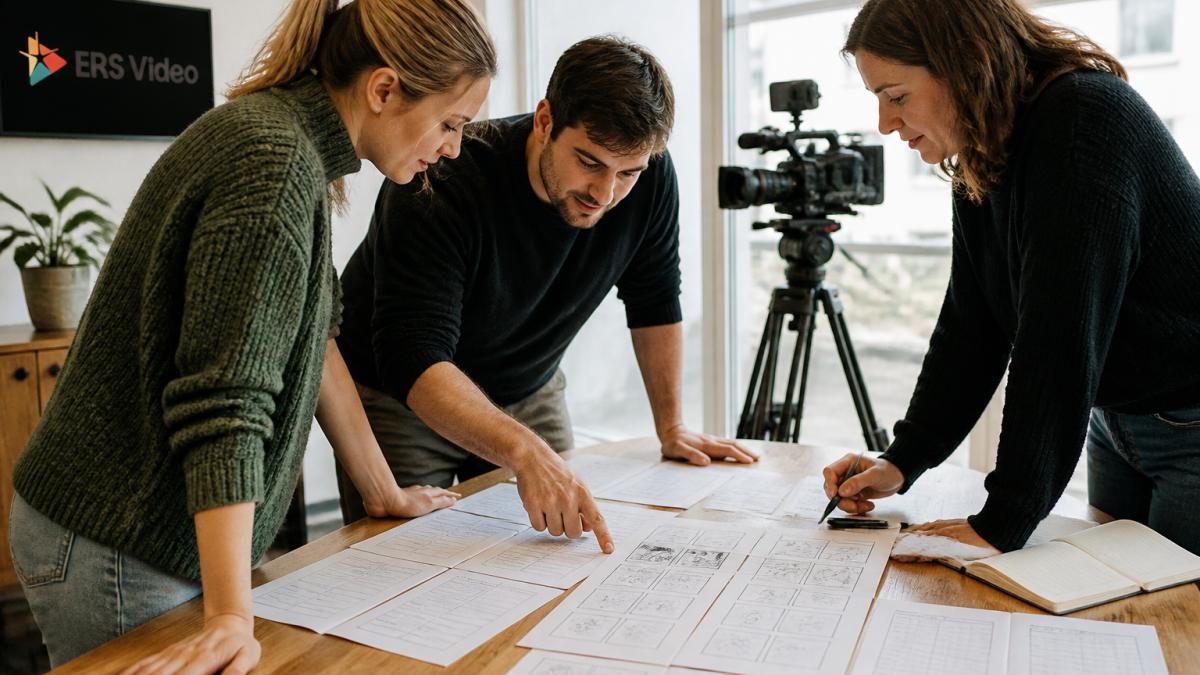
Pre-production is where the video is really made. This stage covers the brief, the script or storyboard, location scouting, scheduling, and permissions.
For a simple promotional video, allow three to seven days. For anything involving multiple locations or interviewees, allow two weeks or more.
A common mistake is rushing this stage to “save time.” It never works. A rushed brief means reshoots, and reshoots cost far more than a longer planning phase.
Production: Filming and Capture
Filming usually takes one to three days for a business video. A single interview setup can be done in half a day. A multi-location shoot with aerial footage takes longer.
Weather, location access, and contributor availability all affect this stage. Outdoor shoots need a backup date. That is not pessimism; it is planning.
Post-Production: Editing and Finishing
Editing is the longest single stage. A short promotional video typically needs three to ten working days for a first cut, then further rounds for revisions, colour grading, sound mixing, and captions.
Revisions are where timelines stretch. Agree the number of revision rounds in writing before the edit begins.
| Stage | Typical Duration | Main Time Risk |
|---|---|---|
| Pre-production | 3-14 days | Unclear brief, slow approvals |
| Production | 1-3 days | Weather, availability, access |
| Post-production | 5-15 days | Feedback rounds, music licensing |
Factors Affecting Video Production Time
Several factors affecting video production time sit outside anyone’s control, and several sit firmly inside yours. The ones inside your control are the ones that matter.
- Script approvals: every extra sign-off round adds days. Nominate one decision-maker.
- Number of locations: each new site adds travel, setup, and permission time.
- Interviewee numbers: more people means more scheduling conflicts.
- Animation and graphics: motion graphics take far longer than filmed footage to build.
- Aerial filming: drone work needs suitable weather and a qualified, insured operator.
- Music and licensing: licensed tracks need clearance; rushed choices limit options.
- Revision rounds: the single biggest cause of overruns.
The most common cause of a blown timeline is feedback by committee. When five people each review a draft separately, edits contradict each other and the edit restarts. Appoint one approver and collect notes in a single document.
How Long to Edit a Corporate Video: Breaking Down the Edit
Editing a corporate video typically takes one to three weeks in total, but the edit itself is several jobs stacked together. Here is how long to edit a corporate video, stage by stage:
- Ingest and organisation: half a day to a day. Footage is backed up and logged.
- Assembly cut: one to three days. The story takes shape.
- Rough cut review: one to two days including your feedback.
- Fine cut: two to four days. Timing, pacing, and transitions are tightened.
- Colour grade and sound mix: one to two days.
- Captions and delivery files: half a day to a day.
The pattern is consistent: the first cut is fast, and the finishing is slow. What most guides miss is that review time counts as editing time. If your team takes four days to return notes, that is four days added to the schedule.
Common Mistakes That Add Time to Your Video Production
Mistakes that stretch timelines are predictable, which means they are avoidable. These are the ones we see most often.
- Changing the brief after filming has started.
- Booking talent or locations before the script is approved.
- Leaving music selection until the final week.
- Expecting broadcast-quality footage from a single filming day.
- Forgetting that captions and multiple video formats need separate exports.
- Assuming AI tools remove the need for planning. They speed up some tasks, but they do not replace a clear brief.
Ask for a delivery schedule in writing before you sign off the brief. A good production company will give you dates for the first cut, the review window, and final delivery. If those dates are vague, the timeline will be too.
How to Plan Your Video Production Timeline
Planning backwards from your launch date is the most reliable method. Start with the date the video must be live, then subtract each stage.
- Week 1: brief, script, and approvals.
- Week 2: location and contributor scheduling.
- Week 3: filming.
- Weeks 4-5: edit, review, and revisions.
- Week 6: final delivery and formats.
Build in a buffer of at least three working days. Something always moves.
If your deadline is fixed, say so at the first conversation. A production team can compress stages, but only if it knows the constraint from day one. At ERS Video, we build the schedule around your campaign date, not ours, and we confirm dates in writing before filming starts.
The Institute of Videography lists qualified professional videographers, which is a useful starting point when checking credentials. For anyone publishing video online, the Information Commissioner’s Office guidance on lawful filming is worth reading before you film people on site.
A video that arrives late is a video that misses its campaign. The fix is not speed; it is a realistic plan with clear approvals and one decision-maker. ERS Video builds bespoke schedules around your launch date, with interviews and filming at your workplace, aerial videography where it adds impact, and a personal, flexible service from brief to delivery. Our clients consistently highlight the value and care in the process, and our reviews are verified by Trustindex with a score above 4.5. Book a call with ERS Video and get a delivery date you can plan your campaign around.
Frequently Asked Questions
What are the three stages of video production?
The three stages are pre-production (planning, scripting, scheduling), production (filming and capturing footage), and post-production (editing, colour grading, sound design, and delivery). Each stage has its own timeline, and how long video production takes overall depends on the complexity of each phase. For a simple corporate video, pre-production might take one week, production one day, and post-production two weeks. Larger projects with multiple locations or animated elements extend these timeframes significantly.
How long does it take to edit a 60-second promotional video?
Editing a 60-second promotional video typically takes between two and five working days. This includes assembling the rough cut, refining timing, adding music and graphics, colour correction, and final sound mixing. The exact time depends on how much raw footage was captured, the number of revisions requested, and whether motion graphics or special effects are involved. A straightforward interview-based promo will sit at the shorter end, while a heavily stylised brand film with animated text will need more time.
Why does video production take longer than expected?
Delays often come from factors affecting video production time such as last-minute script changes, weather disruptions on location, additional revision rounds, or waiting for client feedback. Unclear briefs at the start can also cause rework later. To avoid surprises, agree on a locked script before filming, schedule buffer time for feedback, and confirm locations and contributors well in advance. Experienced production companies build contingency into their schedules, so ask for a realistic timeline rather than the shortest possible one.
How much time should I allocate for pre-production?
For a typical corporate video, allocate one to three weeks for pre-production. This covers concept development, scriptwriting, storyboarding, location scouting, scheduling, and assembling the crew. More complex projects, such as those involving multiple interviewees or aerial videography, may need four to six weeks. Rushing pre-production is a false economy because it leads to longer shoot days and more editing revisions. Investing time upfront in planning reduces the overall time spent on the stages of video production.
