
Quick Summary
Day rates charge for time, so you pay per filming or editing day and the final bill depends on how long the work takes. Project pricing charges one fixed fee for a defined brief, agreed before filming, which gives budget certainty but needs a clear scope.
- Day rates suit projects where the scope is still moving or not yet fully known.
- A day rate does not cap the total, so slow set-ups and long edits can inflate the invoice.
- Project pricing gives budget certainty, but vague briefs lead to disputes over what the fee covers.
- A fair quote should itemise pre-production, filming days, post-production, revisions, deliverables and payment terms.
- Agree a written scope schedule and price any change request as a written variation before the work is done.
Table of Contents
- What Day Rates and Project Pricing Actually Mean
- Advantages and Risks of Day-Rate Pricing
- Advantages and Risks of Project-Based Pricing
- Worked Example: The Same Brief Priced Both Ways
- How to Price Video Production and Build a Fair Quote
- Managing Project Scope and Change Requests
- Choosing Your Model and Requesting a Quote from ERS Video
- Frequently Asked Questions
What Day Rates and Project Pricing Actually Mean
Last Updated: 21 November 2026
If you’re trying to work out what a video production will cost, the difference between day rates and project pricing decides the shape of your quote. A day rate charges for time: you pay per filming or editing day. Project pricing charges for an agreed outcome: you pay one fixed fee for a defined brief. Both can land you in the same place financially, but they spread the risk in very different ways.
Day rates are simple to understand. The supplier quotes a price per day, and the final bill depends on how many days the work takes. Project pricing is a single figure for the whole job, agreed before any camera rolls, covering scope, deliverables and revisions. Many UK production companies use one model or the other, and some offer both.
Clients who ask “what does this cost per day?” are often thinking about control. If you’re still deciding between hiring a full team and outsourcing, alternatives to hiring an in-house video team set out the other routes before you request a quote. Clients who ask “what does the finished film cost?” usually want certainty. Neither question is wrong, but the answer changes how you compare quotes.
Advantages and Risks of Day-Rate Pricing
Day rates suit projects where the scope is still moving. If you’re not sure how many locations, interviews or edits you’ll need, paying by the day lets you stop when the material is good enough.
The main advantages are:
- Flexibility: you can add a shoot day or cut one without renegotiating the whole job.
- Transparency: you can see exactly what each day of filming costs.
- Easier starting point: you can commit to a small test shoot before expanding.
The risks are real, though. A day rate doesn’t cap the total. Slow set-ups, extra takes and a long edit can push the final invoice well past what you expected. Clients with a fixed marketing budget often find this uncomfortable, and it’s a common reason for disagreements at the end of a job.
Watch out: if you agree a day rate without a rough estimate of the number of days, you can end up paying for an open-ended process.
Advantages and Risks of Project-Based Pricing
Project pricing works best when your brief is clear. If you know you need a 90-second promotional film, two interviews and a set of social cut-downs, a fixed fee gives you a number you can budget against.
The advantages are:
- Budget certainty: you know the total cost before the work begins.
- Clear deliverables: the quote lists what you’ll receive, which makes expectations easier to manage.
- Less admin: you don’t need to track days or approve timesheets.
The risks sit on the other side. Vague briefs lead to disputes over what the fixed fee covers. Scope creep becomes a problem quickly, because every extra request is a potential change to the agreed price. A good supplier will price in a contingency, and a good client will understand why. Project management tools for video production can help you track scope, revisions and deadlines once the work is underway.
Worked Example: The Same Brief Priced Both Ways
A side-by-side calculation is the quickest way to see how the two models diverge. Take a manufacturer that wants a 90-second promotional film: one filming day at the factory, two staff interviews, a 60-second social cut-down and one round of revisions.
A third location or a second revision round is a written variation, priced before it is carried out.
Reading the two numbers. The day-rate route can come out cheaper if the client’s team is well prepared and the shoot runs to plan. The project route can cost more on paper, but the client’s exposure is capped at the agreed fee.
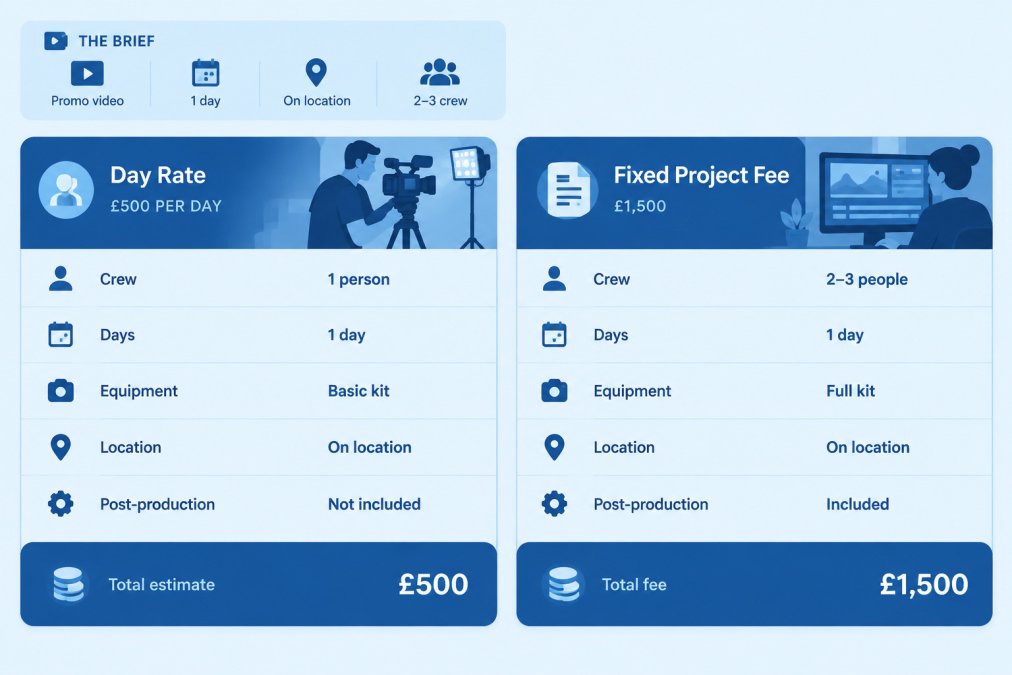
Watch out: a day-rate estimate is not a quote. If the supplier will not put a range on the number of days, treat the headline rate as a starting point rather than a budget figure.
The table below sets out the building blocks a supplier should show in a quote, so the two pricing models can be compared on the same basis.
| Quote item | What to check | Why it matters |
|---|---|---|
| Pre-production | Scripting, location scouting, scheduling | Shows the work before filming starts |
| Filming days | How many, and what each covers | Drives the cost under a day rate |
| Post-production | Editing, grading, sound, graphics | Often forgotten in headline figures |
| Revisions | Rounds included | Limits open-ended changes |
| Deliverables | File formats, lengths, cut-downs | Sets clear expectations |
| Payment terms | Deposit, milestones, final balance | Shows how cash flows over the job |
How to Price Video Production and Build a Fair Quote
A fair quote for video production should show its working. Whether it’s a day rate or a project fee, look for these items:
- Pre-production: scripting, location scouting and scheduling.
- Filming days: how many, and what each covers.
- Post-production: editing, grading, sound and graphics.
- Revisions: how many rounds are included.
- Deliverables: file formats, lengths and cut-downs.
- Payment terms: deposit, milestones and the final balance.
Ask for the quote in writing. A proposal that lists these elements lets you compare suppliers on the same basis, rather than on a headline figure that hides the detail.
Managing Project Scope and Change Requests
Scope creep is the most common reason video budgets overrun, and the fix is contractual rather than conversational. The practical mechanism is a written scope schedule agreed before filming: deliverables, revision rounds, approval turnaround and what counts as out of scope.
Revision limits. State the number of revision rounds included, commonly two on a corporate film, one on a social cut-down, and define what a round is. A round is a consolidated set of comments returned within an agreed window, not a drip-feed of notes over a fortnight. Additional rounds are chargeable at a stated rate, confirmed in the quote.
Variation pricing. A change request should trigger a written variation that sets out the extra cost and the impact on the delivery date before the work is done. Price variations from the same building blocks as the original quote, extra shoot day, extra edit day, additional deliverable, so the client can see the logic rather than a lump sum.
Deposits and milestones. Project pricing is often paid in instalments, such as a deposit on signature, a payment on delivery of the first cut and the balance on final approval. Payment terms should be set out clearly in the contract, and late payment is worth planning for.
Cancellation. Agree what happens if the shoot is called off, and set this out in the contract.
The same discipline matters on day-rate jobs. A daily log of what was shot and what remains helps the client see where the money is going before the invoice arrives, and it gives both sides a shared record if the estimate turns out to be wrong.
Watch out: a fixed fee without a written scope schedule is not a fixed price, it is a dispute waiting to happen.
Choosing Your Model and Requesting a Quote from ERS Video
Choose day rates if your scope is uncertain, you want to test before committing, or you’re happy to manage the shoot closely. Choose project pricing if your brief is clear, your budget is fixed, and you’d rather not track days.
If you’re weighing up a promotional film, an event or a property walkthrough, ERS Video can talk through which model suits your brief. Pricing depends on the scope, the number of filming days, the edit and the delivery format, so the most useful next step is a written brief. Get a quote from ERS Video for current prices and an outline of how each option would look for your project.
Frequently Asked Questions
What is the difference between a day rate and project-based pricing?
A day rate charges for each day a producer or crew spends on your production, so the total moves with time on set and in the edit. Project-based pricing sets one fixed fee for an agreed deliverable, such as a three-minute promotional film with two interviews and one round of revisions. Day rates shift financial risk to the client, because overruns cost more. Project fees shift it to the production company, which must absorb delays. The better choice depends on how certain the brief is.
Is a day rate or a fixed project fee better for video production?
A fixed project fee suits briefs with a clear scope, a known number of deliverables and a set timeline, because you can budget with confidence. A day rate suits projects where the content is still developing, such as documentary-style filming or ongoing social content, where the number of shooting days is uncertain. Many clients use a hybrid, with a day rate for filming and a fixed fee for editing and delivery. Ask any provider to show how the quote is built so you can compare like for like.
How should changes to a project scope be priced?
Changes should be priced separately and agreed in writing before work begins. Common triggers include extra interview subjects, a new location, additional language versions, or a shift in the message after filming. Agree in advance how many revision rounds are included in a fixed fee and what a further round costs. Using a simple change request form, with the new task, the time it adds and the revised total, keeps both sides clear on what has been agreed.
What happens if a project takes longer than expected?
Under a day rate, extra time is billed at the agreed daily rate, so the final cost depends on how long the work takes. Under a fixed fee, the production company usually absorbs the overrun, provided the delay does not come from changes the client requested. Clarify in the contract which delays are the client’s responsibility, such as late approvals or missing assets, and how any resulting extra days will be charged.
