
Table of Contents
- What to Look for in a Video Production Company
- The Benefits of Professional Video Production
- Key Questions to Ask a Video Production Company
- Using a Video Production Brief Template
- Freelancer vs Agency: Which Is Right for You?
- How to Compare Video Production Quotes
- Conclusion
- Frequently Asked Questions
Last Updated: September 27, 2026
What to Look for in a Video Production Company
Choosing a video production company is the difference between footage that sits unused on a hard drive and a film that actually earns its budget back.
So what separates a production partner worth hiring from one you regret? Four things, in order of importance:
- A portfolio that matches your format. A company brilliant at wedding films may never have shot a product launch. Ask for work in your specific category.
- A named point of contact. You want one person accountable from first call to final export, not a rotating cast of freelancers.
- A clear post-production process. Editing, colour grading, sound mixing and revisions should be mapped out before you sign anything.
- Transparent usage rights. Confirm where the finished video can be used, for how long, and on which channels.
The Institute of Practitioners in Advertising guidance on commissioning production is a useful reference for how professional engagements are structured.
The most common mistake is hiring on showreel alone. A polished reel tells you what a company can do, not what it will do for your budget and deadline. Always ask to see a full project delivered end to end.
The Benefits of Professional Video Production
Professional video production delivers three things a phone camera cannot: consistency, credibility and reusability. Marketing teams often underestimate the last one.
A properly produced film becomes a library asset. One shoot day can yield a hero promotional video, short social cuts, interview snippets for your website, and stills for print. When you amortise the cost across every channel, the per-asset figure drops sharply.
There is also the trust factor. Audiences are quick to judge production quality, and a poorly lit, badly dubbed video undermines the message regardless of how good the message is. Bespoke production, by contrast, lets you control lighting, framing and sound so your business looks the way you want it to look.
For small and medium-sized enterprises, this matters most. You are often competing against larger brands with bigger budgets, and a well-made video is one of the few places where craft can close that gap.
The real value of professional production is not one video. It is a reusable bank of footage you can repurpose for years across social, web and sales.
Key Questions to Ask a Video Production Company
Before you commit, ask these questions. The answers will tell you more than any showreel.
Who will actually be on set? Some companies pitch with senior staff and deliver with juniors. Confirm names.
What is included in post-production? Editing, grading, sound and captions are not always bundled. Get the revision policy in writing.
How do you handle changes to the brief? Scope creep is the single biggest cause of budget overruns. Ask how variations are priced.
What do you need from us? Filming at your premises often requires access arrangements, a quiet room and willing participants. Knowing this early prevents delays.
What are the usage rights? Confirm the licence covers your intended channels and duration.
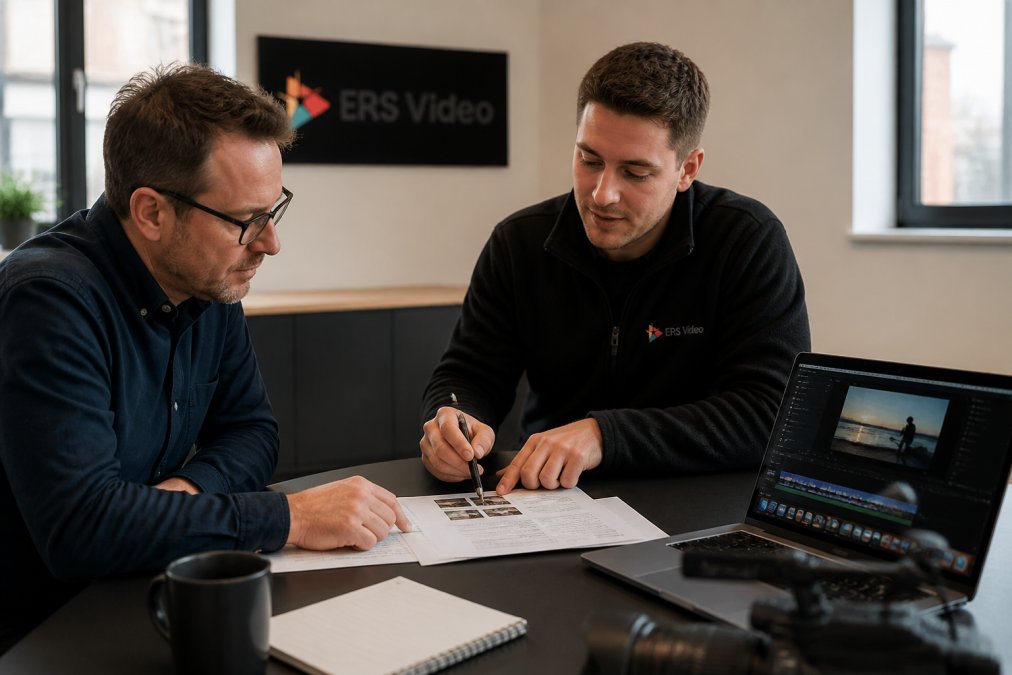
A common mistake is treating the first meeting as a pitch. Treat it as a scoping session. The best production partners will push back on your ideas, and that is a good sign.
Using a Video Production Brief Template
A brief keeps everyone honest. It forces you to articulate the objective before anyone picks up a camera, and it gives the production company a fixed reference point.
Here is a template you can copy and fill in:
Project: [Working title]
Objective: [What should this video achieve? e.g. drive demo bookings]
Audience: [Who is watching, and what do they already know?]
Key message: [One sentence. If you cannot write one sentence, you do not have a message yet.]
Format and length: [e.g. 90-second promotional film]
Deliverables: [Hero video, 3 social cuts, 10 stills]
Tone: [Professional, warm, energetic]
Mandatory content: [Interview subjects, locations, product shots]
Deadline: [Final delivery date, plus any interim milestones]
Budget range: [Be honest. It shapes the creative.]
Approval process: [Who signs off, and at which stages]
Fill this in before you request quotes. Companies that receive a clear brief respond faster and quote more accurately.
Freelancer vs Agency: Which Is Right for You?
Neither is universally better. The right choice depends on scale, complexity and how much hand-holding you want.
A freelancer suits a single-camera interview, a straightforward event, or a tight budget where you are happy to project-manage. You get direct access and lower overheads.
An agency or production company suits multi-day shoots, aerial work, multiple locations, actors, or anything requiring a crew. You get coordination, insurance, backup equipment and a single invoice.
| Factor | Freelancer | Production Company |
|---|---|---|
| Best for | Single-camera, simple briefs | Multi-day, multi-location shoots |
| Crew size | One to two people | Full crew with specialists |
| Aerial videography | Rarely available | Commonly offered |
| Project management | You coordinate | They coordinate |
| Backup equipment | Limited | Standard practice |
| Cost structure | Lower overheads | Higher, but broader scope |
The honest limitation of the freelancer route is resilience. If your one operator is ill on shoot day, the project stalls. A production company absorbs that risk.
How to Compare Video Production Quotes
Quotes are rarely like-for-like, which is why comparing them on price alone is a trap. Compare them on scope.
Line up every quote against the same checklist:
- Number of shoot days and crew members
- Pre-production: scripting, storyboarding, location scouting
- Equipment included, and whether aerial videography is covered
- Post-production: editing, colour grading, sound mixing, captions
- Number of revision rounds
- Final deliverables and formats
- Usage rights and licence duration
- Contingency for weather or illness
A quote that looks cheaper often excludes post-production or limits revisions. A quote that looks higher may include aerial coverage, a second camera and a full day of editing.
Ask each company to break their quote into pre-production, production and post-production. It exposes what is missing far faster than comparing totals.
Where a company cannot give you a fixed figure, ask for a range and the factors that move it. Cost typically depends on shoot duration, number of locations, crew size, aerial requirements and the volume of editing. For a tailored figure based on your brief, ERS Video can walk you through the options.
Conclusion
The hardest part of commissioning video is not the filming. It is knowing which questions to ask before you spend a penny.
ERS Video works with SMEs, marketing managers and private clients across a range of sectors, offering a personal and flexible service, bespoke content, interviews filmed at your premises, and aerial videography when a project calls for it. Clients such as ShieldCrest Book Publishing have described the process as professional and helpful, and our Trustindex-verified review score sits above 4.5.
Get started with ERS Video and turn your next campaign into footage that actually performs.
Frequently Asked Questions
How much does professional video production cost?
Pricing depends on the scope: video length, filming days, locations, animation, aerial work, and editing complexity all affect the total. A simple promotional video costs less than a multi-day shoot with interviews and drone footage. Rather than quoting a fixed figure, ask each company to break down their costs by pre-production, filming, and post-production. Get itemised quotes from at least three companies so you can compare like for like. For a tailored estimate, contact a video production company directly with your brief.
What questions should I ask a video production company before hiring?
Ask about their experience with projects like yours, who will handle scripting and storyboarding, how many revision rounds are included, and what happens if you are not happy with the first cut. Request examples of recent work and client references. Clarify ownership of the final footage and whether raw files are included. Also ask about timelines, payment schedules, and insurance for on-site filming. A good company welcomes these questions and answers them clearly.
Should I hire a freelancer or a video production agency?
Freelancers often cost less and suit simple projects like single-camera interviews or event coverage. Agencies bring a full crew, multiple specialists, and can manage complex shoots with drone work, multiple locations, and animation. For a promotional video that needs to represent your brand at a high standard, an agency or established production company usually delivers more consistent results. Consider your budget, timeline, and how much hand-holding you need.
How long does the video production process take?
A straightforward promotional video typically takes three to six weeks from brief to final delivery. Pre-production (planning, scripting, scheduling) takes one to two weeks. Filming usually happens in one or two days. Post-production, including editing, colour grading, and revisions, takes another two to three weeks. Complex projects with animation or multiple locations can take longer. Always confirm timelines upfront, especially if you have a campaign launch date.